• Log In
 Visit the Pennsylvania State University Home Page

Copyright Information

For university teaching and research

  • Copyright
    • Fair Use
    • Creative Commons Licenses
    • Permission and Licenses
    • Public Domain
    • TEACH Act
    • Copyright for Theses and Dissertations
    • External Resources
  • Open Access
  • Workshops
    • Intro Series
  • Contact
  • Appointments
  • Blog
  • Faculty & Staff
  • Students
  • Fair Use
  • PSU Policy
    • Other Places for Help
  • FAQ

Summer 2024 Workshops

May 20, 2024 by Ana Enriquez

We are happy to announce summer workshops from the Office of Scholarly Communications and Copyright. All of these workshops will take place on Zoom. These workshops are open to the Penn State University community and the public. SARI credit is available for several of these workshops. Please register in advance using the links below.

For more information about our workshop program, please visit our Workshops page. With questions, please contact us at copyright@psu.edu.

Penn State encourages qualified persons with disabilities to participate in its programs and activities. If you anticipate needing any type of accommodation or have questions about the physical access provided, please contact us at copyright@psu.edu in advance of your participation or visit.

Copyright in One Hour, June 4, 10-11 a.m., Zoom

Please register on Zoom.
This workshop provides a brief introduction to U.S. copyright law, focusing on its impact on university research and teaching. You will learn what copyright covers and how copyrighted works enter the public domain. You’ll also learn about fair use and other rights that copyright gives to people using copyrighted material. This workshop will also serve as an introduction to the Summer 2024 workshop series from the University Libraries’ Office of Scholarly Communications and Copyright. Ana Enriquez will teach this workshop. Participants will earn SARI credit.

Using the Researcher Metadata Database, June 6, 10-11 a.m., Zoom

Please register on Zoom.
In this training, you will learn how to use the Researcher Metadata Database to share your scholarly articles with the public under Penn State’s open access policy. You will also learn other options for following up with open access policy reminder emails, including uploading files in Activity Insight, providing links to open copies of your articles, or getting waivers of the policy. Ana Enriquez will teach this training.

Sharing Research Software with Open Source Licenses, June 6, 4-5 p.m., Zoom

Please register on Zoom.
Open source software development is increasingly common in many areas of academic work, however researchers who write software must balance a host of disciplinary and institutional expectations to share their code. This workshop provides an introduction to open source software licensing with particular focus on the needs of Penn State researchers. Topics include: the importance of software licenses, common open source licenses used in scientific software projects, and recommendations for navigating relevant university and funder policies. Ana Enriquez will teach this workshop. Participants will earn SARI credit.

Plagiarism and Attribution, June 18, 10-11 a.m., Zoom

Please register on Zoom.
This workshop will provide an introduction to plagiarism and attribution, including an overview of university policies related to these topics. You will learn how plagiarism differs from copyright infringement and when attribution is relevant to copyright law. You will also learn about text recycling (sometimes called “self-plagiarism”) and about plagiarism and attribution as they relate to the use of generative AI tools such as ChatGPT. Ana Enriquez will teach this workshop. Participants will earn SARI credit.

Copyright and Generative AI, June 18, 4-5 p.m., Zoom

Please register on Zoom.
This workshop will provide an introduction to copyright issues related to generative AI tools such as ChatGPT, Copilot, and Stable Diffusion. The law in this area is in flux, so we’ll study recent developments as well as relevant precedent on three questions. Are works created with generative AI tools copyrightable? Is it fair use to train a large language model on in-copyright material? And finally, is it fair use to use a generative AI tool to create a new work that is “substantially similar” to an in-copyright work? Ana Enriquez will teach this workshop. Participants will earn SARI credit.

Copyright in Three Hours, June 20, 1-4 p.m., Zoom

Please register on Zoom.

This workshop provides a detailed introduction to U.S. copyright law. Through a combination of prerecorded videos, small group discussion, full group discussion, and short breaks, you will learn to apply copyright law to scenarios like those that come up at Penn State, including research- and course-related uses. This workshop will go into additional detail on the topics covered in the Copyright in One Hour workshop (copyrightability, the public domain, and fair use). It will also cover additional topics, including how courts determine whether one work counts as a copy of an earlier work, who counts as the author of a copyrighted work (including jointly authored works and works made for hire), and how copyrights are licensed or transferred. This workshop is recommended for participants who want to bring together previous copyright training into a holistic understanding of U.S. copyright law. Ana Enriquez will teach this workshop.

Using Creative Commons Licensed Material, June 25, 2-3 p.m., Zoom

Please register on Zoom.
Don’t understand the difference between Creative Commons ShareAlike and NoDerivatives licenses? Aren’t sure where to find great Creative Commons licensed content? Do you want to license your content with a Creative Commons license but don’t know which one to use? Are you curious about Creative Commons licenses? Join Danielle Steinhart, Copyright Specialist, for a workshop on these and other questions. This is an interactive workshop. After an overview from Danielle, workshop participants will work in small groups to address hypothetical Creative Commons questions and then debrief their responses as a full group. Participants will earn SARI credit.

Copyright and Accessibility, June 27, 2-3 p.m., Zoom

Please register on Zoom.
Are you curious about how copyright law interacts with making copyrighted works accessible to people with disabilities? Not sure if you can remediate a pdf for readability or add captions to a video? This workshop is for you. Join Danielle Steinhart, Copyright Specialist, for a workshop on these and other questions. This is an interactive workshop. After an overview from Danielle, workshop participants will work in small groups to address hypothetical copyright questions and then debrief their responses as a full group..
Filed Under: Copyright Law, PSU Copyright News, Scholarly Communications

Racism in Scholarly Communications and Actions You Can Take

September 23, 2020 by Ana Enriquez and Brandy Karl

This post was prepared collaboratively by Brandy Karl and Ana Enriquez. We thank Racine Amos, Carmen Cole, Lauren Cooper, Angel Diaz, and Jennifer Meehan for their feedback on a draft of this post. Any errors are our responsibility. 

This post outlines a few examples of racism related to scholarly communications. The resources below can help you learn about these issues. We have chosen not to provide summaries of the resources — instead, we provide brief quotes or descriptions, in hopes that you will read the resources themselves, reflect on them, and take action to change your own practices in these areas. In addition to changing your own practices, we hope you take action to support and encourage others in doing this work, including colleagues, students, administrators, academic units, colleges, libraries, archives, museums, scholarly societies, editorial boards, and publishers.

Misattribution of Black scholarship and failure to cite Black scholars perpetuates racism.

  1. April Hathcock, Director of Scholarly Communications & Information Policy at NYU Libraries, describes the experience of learning that her writing about the colonialism of learning analytics “was wholly subsumed by and cited to the work of a white man” in Against the Grain: At It Again, May 30, 2020. 
  2. Gabrielle Foreman, Paterno Family Professor of American Literature and Professor of African American Studies and History at Penn State, writes that “[a]ctual language from a ‘Talking/Teaching/Writing about Slavery’ guide [she] curated got thousands of RTs/likes . . . without citation,” Tweet, June 17, 2020. 
  3. Action you can take: Christen A. Smith, Associate Professor of African and African Diaspora Studies and Anthropology at University of Texas – Austin, outlines five guiding principles for citing Black women in Cite Black Women: A Critical Praxis, December 21, 2018.

Many academic institutions in the U.S. are built on lands taken from Indigenous people and continue to benefit from Indigenous dispossession.

  1. Action you can take: Learn whose lands you live and work on with Native Land, “a resource for North Americans (and others) to find out more about local Indigenous territories and languages.”
  2. Action you can take: Acknowledge the people on whose lands you live and work, but don’t stop there. 
    1. “Land acknowledgment alone is not enough. It’s merely a starting point. Ask yourself: how do I plan to take action to support Indigenous communities?” writes the Native Governance Center in A guide to Indigenous land acknowledgment.
    2. “The time is long overdue for everyone to open all public events and gatherings with acknowledgment of the traditional Native inhabitants of the land,” writes The U.S. Department of Arts and Culture in Honor Native Land: A Guide and Call to Acknowledgement.
  3. “[L]and-grant universities were built not just on Indigenous land, but with Indigenous land.” Land-grab universities, an investigation for High Country News by Robert Lee, lecturer in American History at the University of Cambridge, and Tristan Ahtone, editor-in-chief of the Texas Observer, documents the role of the Morrill Act in Indigenous dispossession in the United States. 
  4. Examples of Land Acknowledgments in U.S. Academia
    1. Northwestern University Land Acknowledgement 
    2. Colorado State Land Acknowledgment
    3. Michigan State Land Acknowledgement
    4. Ohio State American Indian Studies (AIS), ODI, and MCC Land Acknowledgment 
    5. Homepage of Eric Baković (UCSD), with land acknowledgment 

Misgendering trans people of color magnifies the multiplicity of harms at the intersection of systemic racism and transphobia.

  1. In Black Trans Women and Black Trans Femmes: Leading & Living Fiercely, the Transgender Law Center writes that, “Trans people, trans people of color, and especially Black trans women and Black trans femmes are already disproportionately impacted by discrimination while working. This discrimination leads to higher rates of poverty, poorer health outcomes, and increased likelihood of experiencing violence in other areas of life. As a result, Black trans women and Black trans femmes face disproportionately higher rates of violence, including police violence, as well as harassment and discrimination by government agencies and the courts.” 
  2. Action you can take: Respect trans people by always using correct pronouns. Cis people can help to create inclusive spaces by providing their pronouns. Learn more with MyPronouns.org, authored by Shige Sakurai, Director of Leadership Initiatives and Associate Director of the LGBT Equity Center at University of Maryland, College Park.

Systemic inequities in academic publishing perpetuate racism.

  1. Action you can take: “These inequities create obstacles for faculty from marginalized groups from continuing and advancing in their careers,” writes the Library Publishing Coalition in An Ethical Framework for Library Publishing. Read the guide for suggestions on how to address these inequities, including in geography and language, scholarship formats, and the editorial and peer review process.

Traditional citation practices reduce the visibility of those who aren’t first authors.

  1. Using ‘First Author, et al.’ in the first citation to a work fails to acknowledge the work of those that aren’t first authors and creates barriers to the advancement of their careers by reducing the visible credit to junior scholars.
  2. Action you can take: Penn Law Review writes, “Our internal style guide now institutes a strong pref. for listing a source’s first 10 authors upon 1st citation. We applaud the fair citation campaign’s goal but regret how it’s obscured the heart of the issue: that BIPOC & women are systemically excluded from legal academia.” Tweet Thread, September 15, 2020.

The language used to describe people can obscure them.

  1. Action you can take: Instead of “slave” use “enslaved person” to acknowledge the human agency and “enslaver” instead of “slave master” so as not to promote a desired status. P. Gabrielle Foreman and scholarly collaborators, “Writing about Slavery/Teaching About Slavery: This Might Help.”
  2. Action you can take: Ask Indigenous people how they want to be identified and use the terms they prefer.
    1. Michael Yellow Bird, Dean of the Faculty of Social Work at the University of Manitoba, writes in “What We Want to Be Called: Indigenous Peoples’ Perspectives on Racial and Ethnic Identity Labels” [access for PSU] “At minimum all Indigenous Peoples should be asked how they want to be identified or what they want to be called.”
    2. The Native American Journalists Association (NAJA) discusses the need to use specific, accurate terminology when writing about Indigenous people in the NAJA Reporting and Indigenous Terminology Guide (PDF), “[f]ailing to use the actual name of the tribe you are reporting on is neither accurate, fair or thorough and undermines diversity by erasing the tribe’s identity.” “Reporters unsure of names and terms should ask the Indigenous people they are reporting on which words are preferred, or access tribal government websites for correct nomenclature.”
    3. See additional guides relating to writing about Indigenous peoples in University of Michigan Multicultural Studies Librarian Charles Ransom’s Terminology Page – Indigenous Resources Research Guide.

Racist phrases and words pervade our language.

  1. In “Tulsa Race “Riot” Commission is causing division in Tulsa,” Nehemiah D. Frank, Editor in Chief of The Black Wall Street Times and a middle school teacher at Sankofa School of the Performing Arts, writes, “Referring to the [1921 Greenwood Massacre] as a riot is a form of social conditioning. You are telling the children that what happened in Greenwood was a disturbance and not a deliberate attack on a community…. White supremacy has used social conditioning especially through classrooms as a means to oppress marginalized people through the centuries.”
  2. Action you can take: In “Second Thoughts on Colonial Historians and American Indians” [access for PSU] James Merrell, Professor of History on the Lucy Maynard Salmon Chair, provides alternatives to archaic, Eurocentric vocabulary that perpetuates colonialism.
  3. Action you can take: Everyday words and phrases that have racist connotations, by Scottie Andrew and Harmeet Kaur for CNN, discusses biased English-language phrases. The article quotes Elizabeth Stordeur Pryor, Associate Professor of History at Smith College, as saying, “Language works best when it brings as many people [as possible] into communication with each other. . . . If we know, by using certain language, we’re disinviting certain people from that conversation, language isn’t doing its job.”

Filed Under: Scholarly Communications

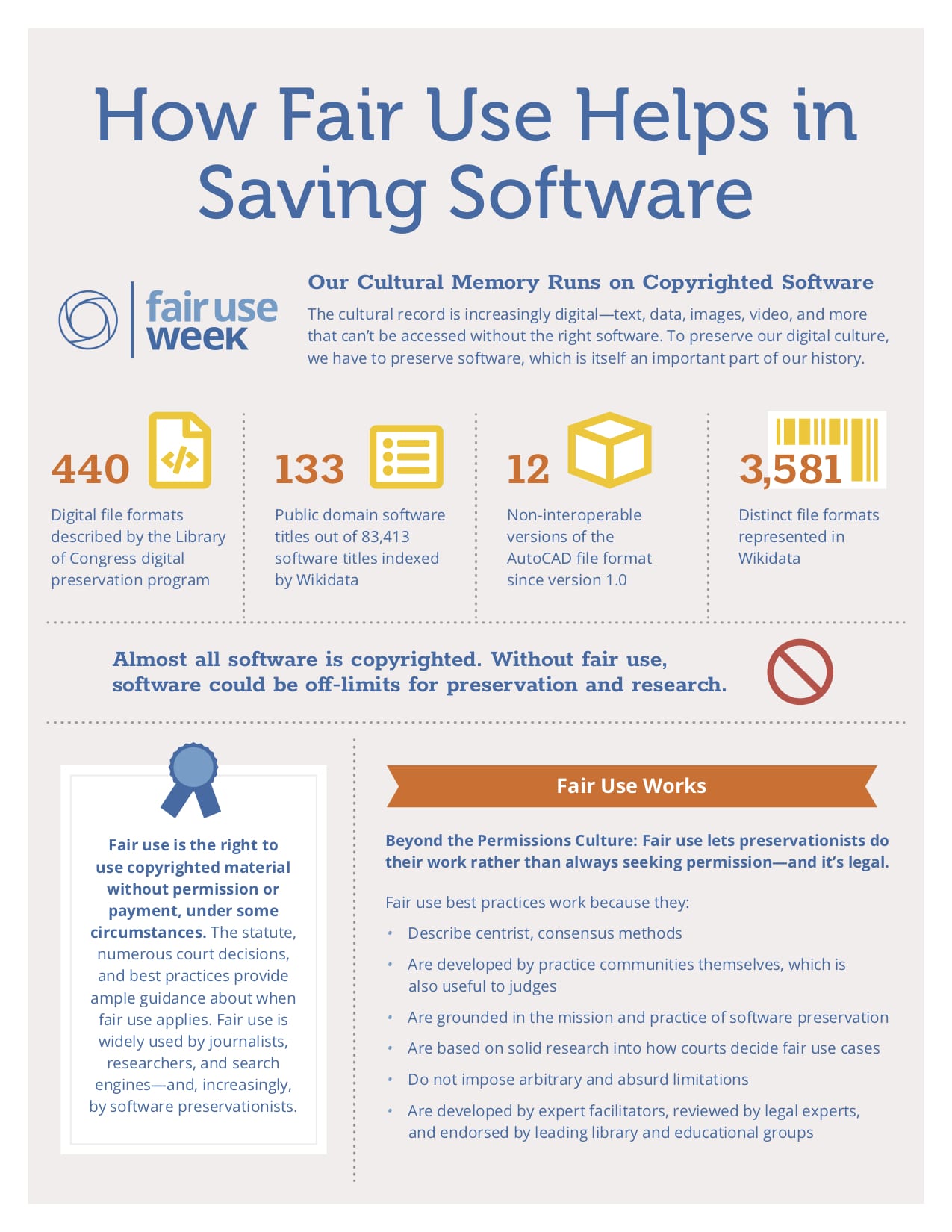
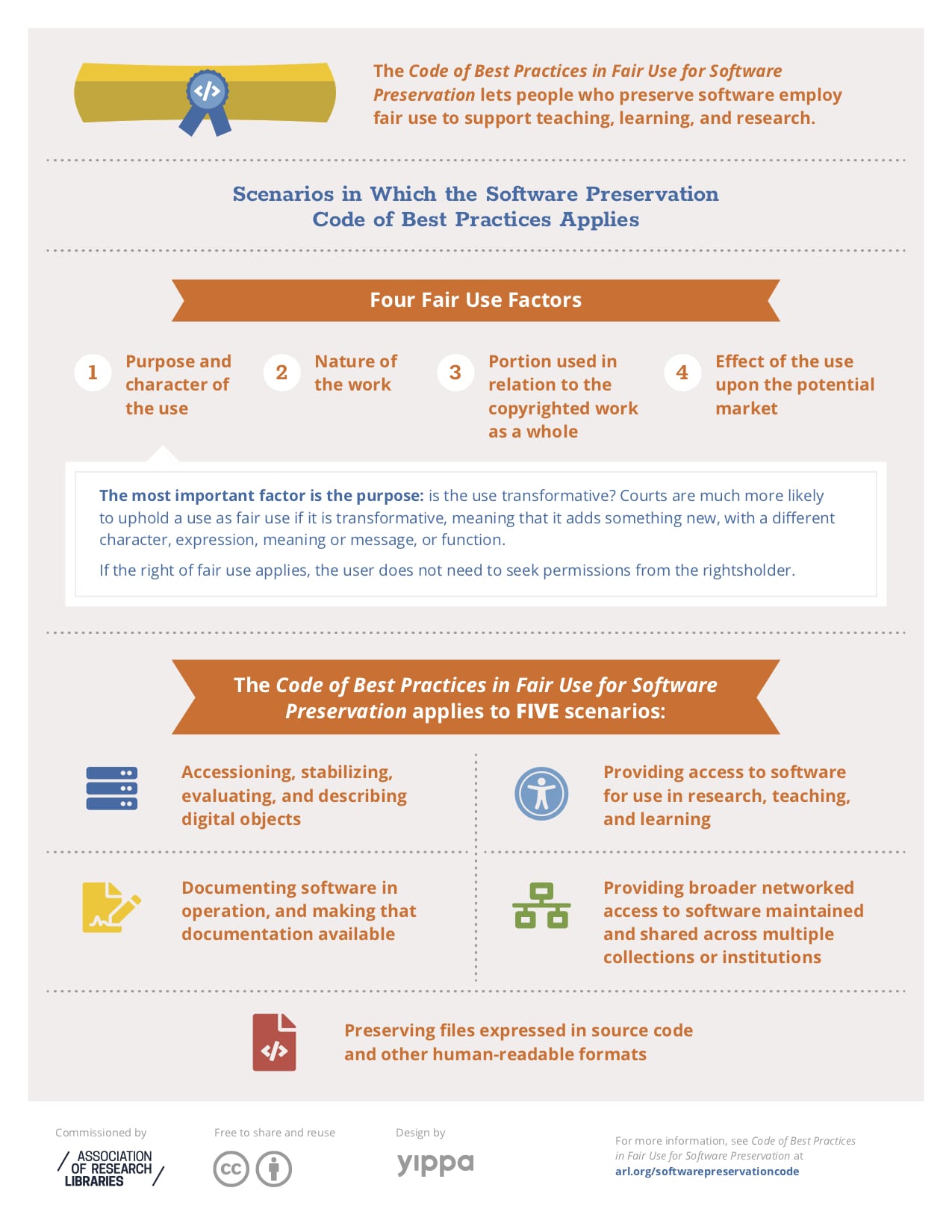
Software Preservation + Fair Use at Penn State Libraries #WeAreFairUse

February 26, 2019 by Brandy Karl

From the Association of Research Libraries (CC BY), check out this infographic: How Fair Use Helps in Saving Software

PSU Libraries’ Software Curation Librarian, Seth Erickson, is working to identify software of cultural and scientific value in order to support both historical work on software and reproducibility in science. As a member of the Software Preservation Network, Penn State Libraries is at the forefront of efforts to develop standards and library services that facilitate long-term preservation and access to software.


See the full Code of Best Practices for Fair Use in Software Preservation, which guides practitioners on how and when to employ fair use in software preservation practices.

Filed Under: Fair Use Tagged With: Fair Use Week 2019, Infographic

Introducing Penn State’s Scholarly Communications Outreach Librarian

October 26, 2018 by Ana Enriquez

Photograph of Ana Enriquez
I joined the Penn State University Libraries earlier this term and have been enjoying getting to know the university. As Scholarly Communications Outreach Librarian, I provide the following services:

  • Consultations with faculty, students, and staff about scholarly publishing, including fair use, permissions, and negotiating publishing contracts
  • Support for university researchers complying with funder public access and open access policies
  • Open workshops on scholarly publishing and copyright (also available on demand for university units and groups)
  • Reference consultations on copyright

To book a consultation with me, please use the “Schedule Appointment” option on this site. To contact me and the rest of the libraries’ copyright, publishing, and open access experts, please use the request form.

I will be holding several open workshops over the coming weeks. To learn more or register, please navigate to LRN using the links below:

  • Copyright for Scholarly Authors
    • November 1 (Thursday), 2:00 to 3:00 p.m., Pattee W-315
    • November 5 (Monday), 2:30 p.m. to 3:30 p.m., Zoom
  • Complying with the NSF Public Access Policy
    • November 6 (Tuesday), 12:30 to 1:00 p.m., Zoom
  • Negotiating Publishing Contracts
    • November 8 (Thursday), 3:00 p.m. to 4:30 p.m., Pattee W315
    • November 14 (Wednesday), 3:00 p.m. to 4:30 p.m., Zoom
  • Introduction to Copyright
    • November 15 (Thursday), 1:30 p.m. to 3:30 p.m., Pattee W-315

Filed Under: Uncategorized

Fair Use + Reuse = More Knowledge #WeAreFairUse

February 27, 2018 by Brandy Karl

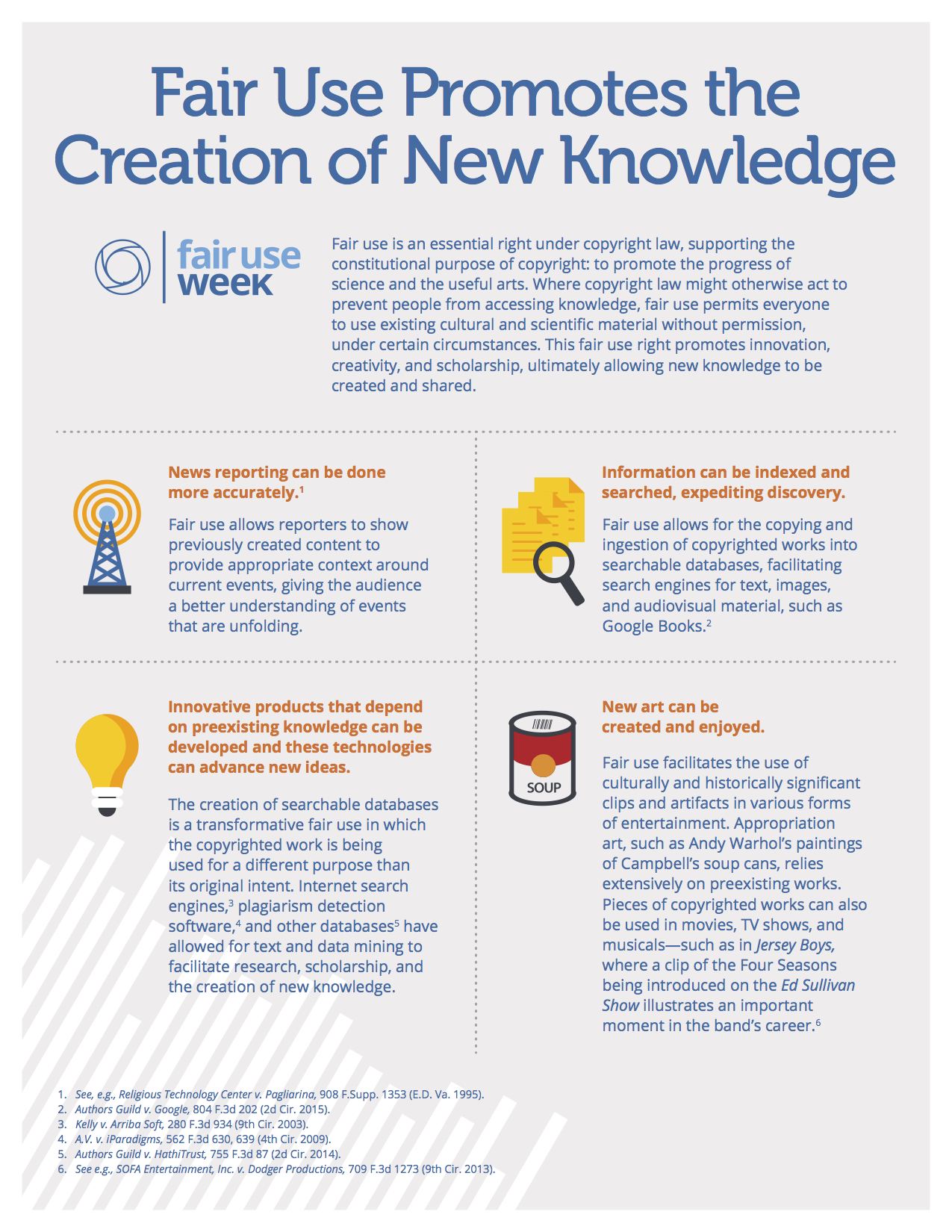
A great look at how fair use promotes the creation of new knowledge. From the Association of Research Libraries (CC BY), check out this infographic.

Fair Use leads to innovation and new knowledge creation

This infographic illustrates how fair use advances innovation, creativity, and scholarship, ultimately allowing new knowledge to be created and shared.


SaveSave

Filed Under: Fair Use Tagged With: Fair Use Week 2018, Infographic

Requesting Removal of Infringing Material

August 23, 2017 by Brandy Karl

Getting third party websites to remove your course materials

PSU Faculty often contact the Office of Scholarly Communications and Copyright and/or the General Counsel’s Office for assistance in getting course materials removed from online sites. Of note:

  1. PSU cannot make the request on your behalf, if you own the material: Unless the course is for World Campus, created pursuant to a written agreement between the faculty/staff member or the unit, or if the work is considered University-directed by the standing policy of the unit, the faculty member owns the copyright in instructional IP. (See IP01 and IP03 for further clarification)
  2. Students have the right to take and share non-infringing notes: Further, “A registered student lawfully may take original hand written or typed notes during an oral lecture presentation and may sell those notes in the free marketplace. The notes may be subject to copyright protection, provided the notes represent an original work of authorship, but any such copyright would not impact in any manner on the faculty member’s ownership of the subject matter presented orally, nor the hard copy materials presented and/or distributed during the lecture.” (AD40)

You may want to check with your chair to confirm that it’s the policy of your unit that you own the rights in a particular set of instructional materials or courseware before taking action.

Many faculty members allow the sharing of their instructional materials as OER, but wish to prohibit the sharing of assessment materials, including rubrics, quizzes, tests, etc. Faculty members may want to remind students that they do not have permission to post prohibited materials on course-sharing or other websites.

Sites where course materials are often shared

Course Hero http://www.coursehero.com/
Fratfolder http://fratfolder.com/
Rock My Midterm http://rockmymt.com/
ScribD http://www.scribd.com/
Notehall http://www.notehall.com/
Koofers http://www.koofers.com/
CampusBuddy http://www.campusbuddy.com/


HOW TO REQUEST THE REMOVAL OF INFRINGING MATERIAL

To have materials removed from a web site under the Digital Millennium Copyright Act (DMCA), the copyright owner or agent must write to the infringing site’s DMCA agent and/or Internet Service Provider (ISP) and file a valid takedown request. The notice must include the information specified in 17 U.S.C. 512(c).

Consequences Of Filing A False DMCA Takedown Request

Do remember that DMCA notices should not be sent for content to which you do not own the copyright, including non-infringing student notes.

  • Criminal sanctions may apply to senders of false DMCA takedown requests because the requests are sent under the penalty of perjury.
  • Monetary sanctions may apply to senders of DMCA takedown requests where no copyright infringement is found, including where a fair use of material has been made.

Sample DMCA Takedown Notice

Here’s a sample [Also downloadable as a Word Document]

[Insert Date] 

[Insert name, address, and email of DMCA Agent for Infringing Entity]

As of August 2017, the DMCA Agent for Course Hero is:

Terry Park

Course Hero, Inc.

1400B Seaport Blvd.

Second Floor

Redwood City,  CA  94063

Phone: 888-634-9397

Email: dmca@coursehero.com

RE:  NOTICE OF COPYRIGHT INFRINGEMENT

Dear [Insert Name of Registered Agent (i.e., Mr. Park)]:

It has recently come to my attention that [Company Name and URL (i.e., Course Hero (www.coursehero.com)], in violation of U.S. copyright laws, reproduces, displays, distributes, and hosts my copyrighted works without my authorization.  This communication serves as official notice of copyright infringement pursuant to the Digital Millennium Copyright Act (”DMCA) 17 U.S.C. § 512(c).  I am providing this notice in good faith and with the reasonable belief that my rights, as the exclusive rights holder, are being infringed.

I am the owner and exclusive rights holder of the following copyrighted material(s) that is(are) posted without authorization on your website.

Option 1:  When one URL covers multiple copyrighted works, you may provide that single URL and identify representative documents.  Use the following sentence: 

“Given that there are multiple infringements of my copyrighted works at a single URL on your site, I am required to provide only a representative list of the infringed works (§ 512(c) (3) (A) (ii), (iii)):   [Insert URL and then a list of the titles of representative documents]”

To avoid a back-and-forth with the copyright infringer, we suggest listing ALL documents, if possible.

Option 2:  If the copyrighted material are at separate URLs, you need to provide the URL for each individual document that is infringed.  Use this sentence: “The infringed works are located at the following URLs (§ 512(c) (3) (A) (ii), (iii)):  [Insert URL and list of the infringed titles; Insert URL and list of infringed titles description; repeat until all URLs and titles are provided.]”

I confirm that the information in this notification is both true and accurate, and under penalty of perjury, that I am the owner of the copyrighted material identified above.

Please be advised that upon receipt of this notice, you, as the designated agent of [Insert Company Name (i.e., Course Hero, Inc.], must respond expeditiously to remove or disable access to the materials identified above as being the subject of infringement. Please provide me, within seven (7) days of this notification, written assurance that [Insert Company Name (i.e., Course Hero, Inc.] will comply with my request.  Should you wish to discuss this matter with me, please contact me directly at the following address/email.

[Your Name]

The Pennsylvania State University

[Your Office Mailing Address]

University Park, PA 16802

Telephone:

Email:

I look forward to your prompt attention to this matter.

Sincerely

[Insert electronic signature]( i.e., /Name/”)

[Insert name]


Filed Under: Uncategorized

Copyright & Fair Use Comic Books

May 24, 2017 by Brandy Karl

Looking for awesome resources to help learn and teach about copyright in a fun easy to understand way? Check out these free Copyright comics! The first and third are full-length graphic novels and are available under Creative Commons Licenses.

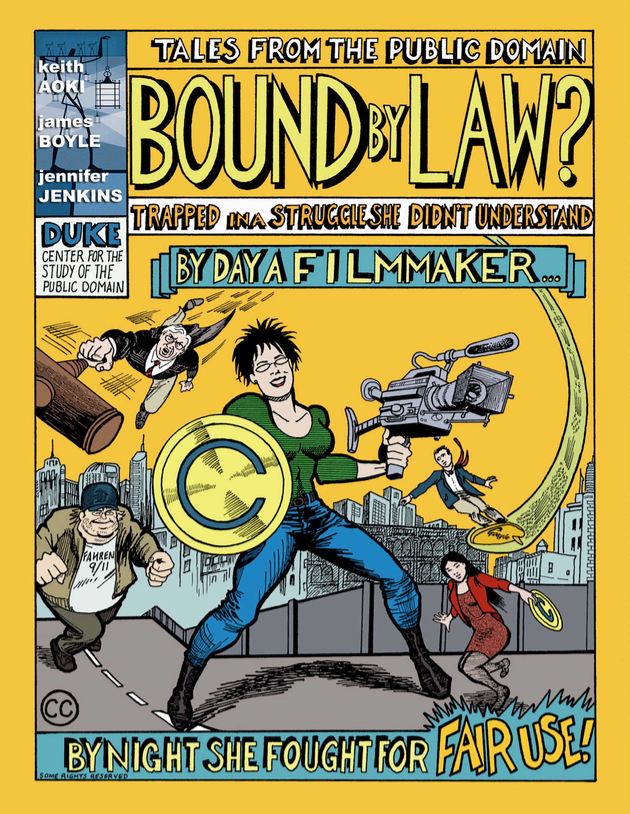
Tales from the Public Domain: BOUND BY LAW?

James Boyle, Jennifer Jenkins and Keith Aoki

“Bound by Law translates law into plain English and abstract ideas into ‘visual metaphors.’ So the comic’s heroine, Akiko, brandishes a laser gun as she fends off a cyclopean ‘Rights Monster’ – all the while learning copyright law basics, including the line between fair use and copyright infringement.” -Brandt Goldstein, The Wall Street Journal online

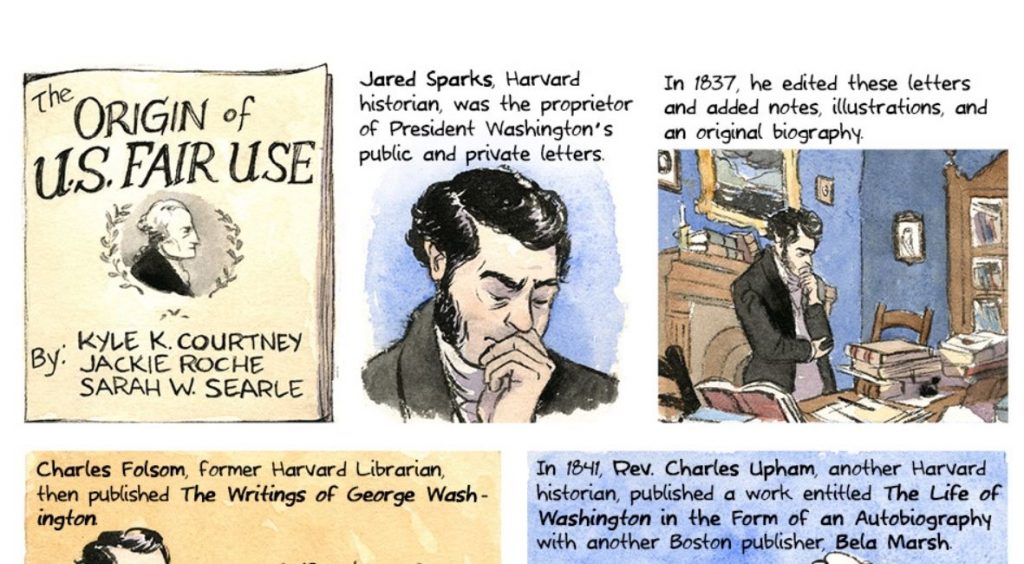
The Origin of U.S. Fair Use

Kyle K. Courtney and Sarah W. Searle, authors, and Jackie Roche, illustrator and author

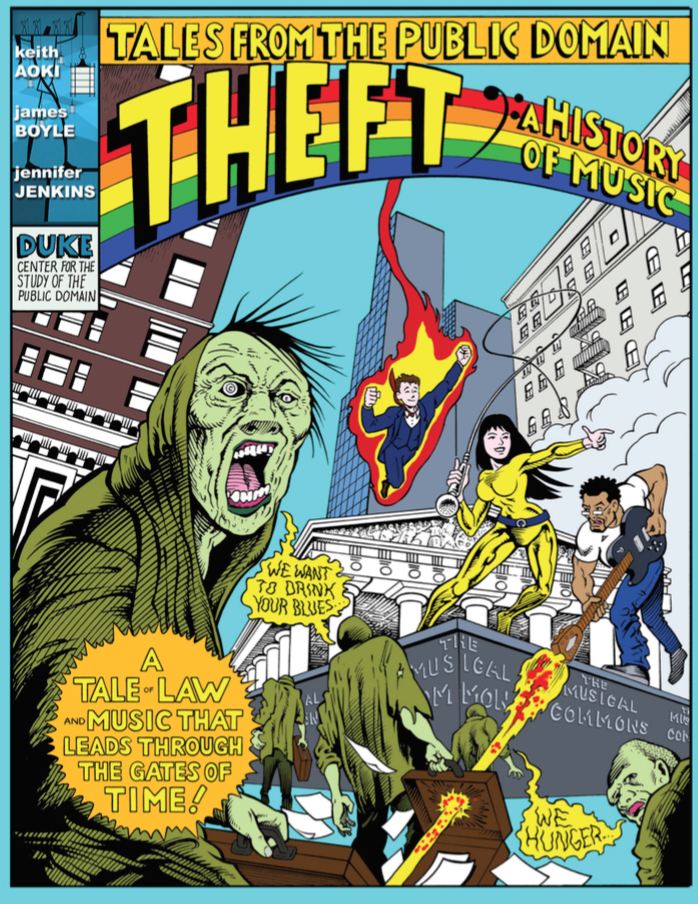
Theft! A History of Music

James Boyle, Jennifer Jenkins and Keith Aoki

This comic lays out 2000 years of musical history. A neglected part of musical history. Again and again there have been attempts to police music; to restrict borrowing and cultural cross-fertilization. But music builds on itself. To those who think that mash-ups and sampling started with YouTube or the DJ’s turntables, it might be shocking to find that musicians have been borrowing—extensively borrowing—from each other since music began. Then why try to stop that process? The reasons varied. Philosophy, religion, politics, race—again and again, race—and law. And because music affects us so deeply, those struggles were passionate ones. They still are.

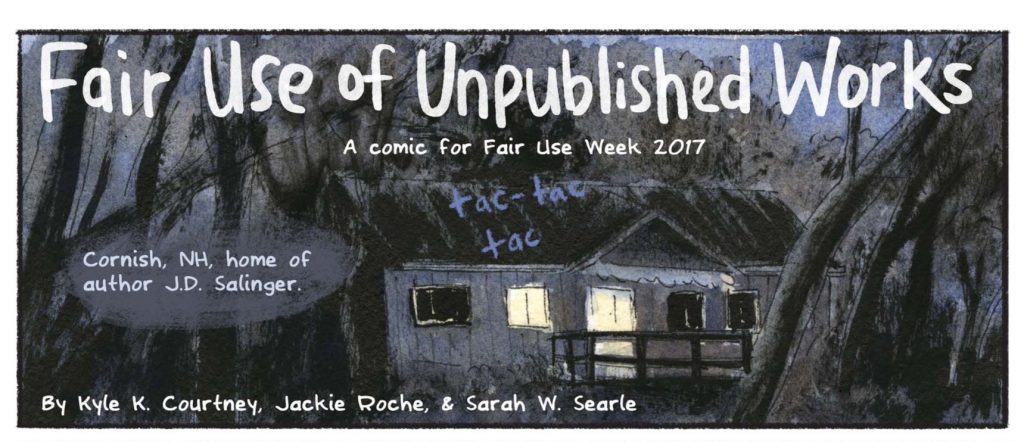
Fair Use of Unpublished Works

Kyle K. Courtney and Sarah W. Searle, authors, and Jackie Roche, illustrator and author

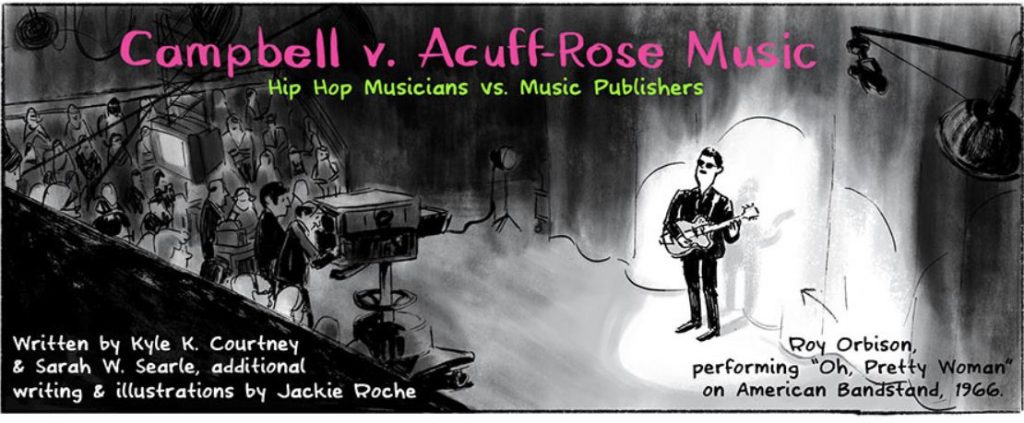
Campbell v. Acuff-Rose Music: Hip Hop Musicians vs. Music Publishers

Kyle K. Courtney and Sarah W. Searle, authors, and Jackie Roche, illustrator and author

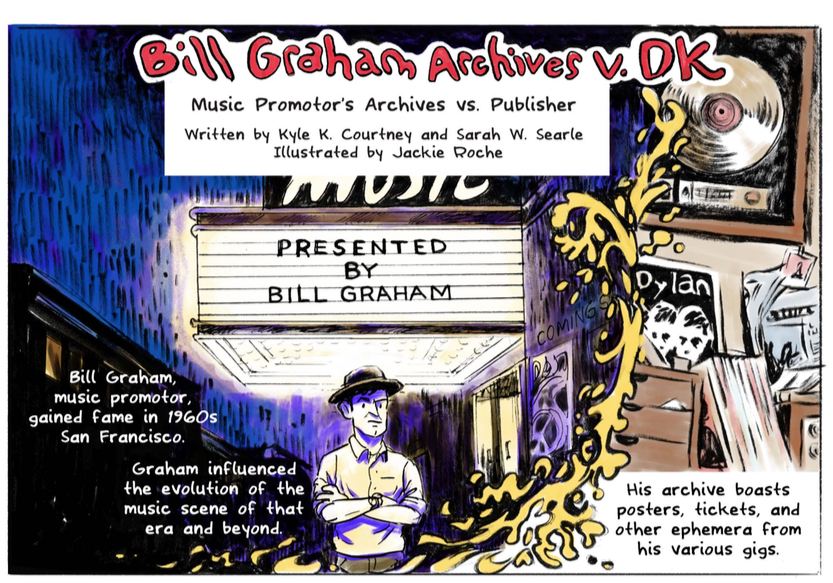
Bill Graham Archives v. DK: Music Promoter’s Archives vs. Publisher

Kyle K. Courtney and Sarah W. Searle, authors, and Jackie Roche, illustrator and author

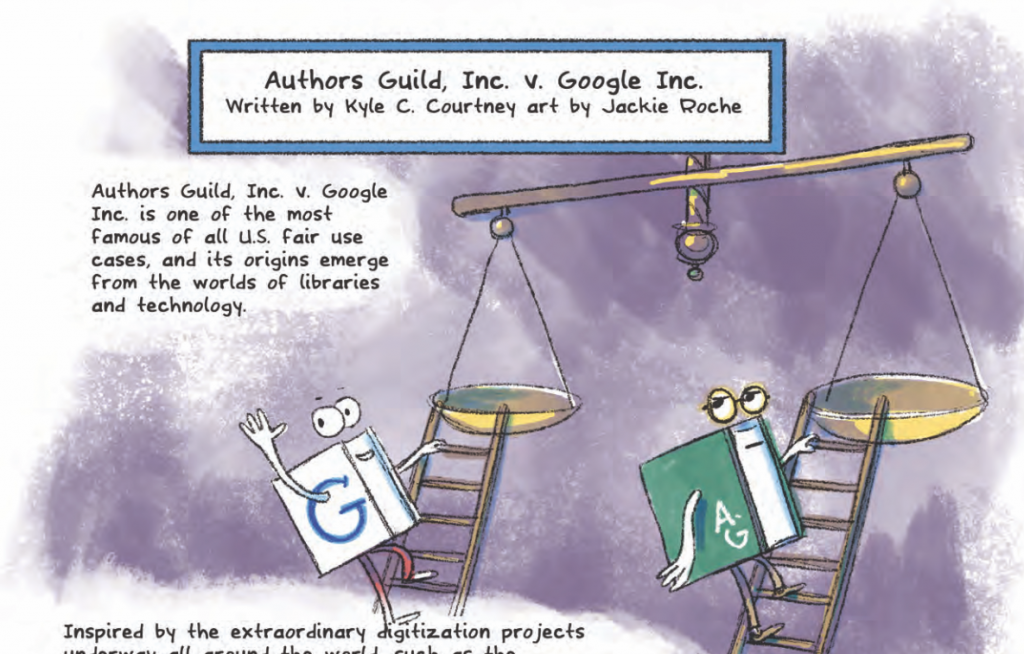
 Authors Guild, Inc. v. Google Inc. case

Kyle C. Courtney, art by Jackie Roche.

SaveSave

SaveSave

SaveSave

Filed Under: Copyright Law, Fair Use

I received a notice of Copyright Infringement, What do I do now?

February 27, 2017 by Brandy Karl

Receive a notice of infringing activity from Security Operations and Services?  What does it mean?

It’s against University Policy to distribute infringing files using the network. Typically users receive this type of notice because they’ve been distributing an infringing file over the PSU network, most frequently using file-sharing software.

But I only downloaded a file?!

Most file-sharing software is set to default to “seeding” – when you download a file you also become a distributor of that file. Regardless of whether you distributed or downloaded, it’s still a violation of PSU Network Policy

The use of your network connection for any activity that violates any local, state, federal, or international law, order or regulation is a violation of this policy.

Prohibited activities include, but are not limited to:

  • Posting or disseminating material which is unlawful (such as child pornography or obscene material).
  • Disseminating material which violates the copyright or other intellectual property rights of others. You assume all risks regarding the determination of whether material is in the public domain.
  • Pyramid or other illegal solicitation schemes.
  • Any fraudulent activities, including impersonating any person or entity or forging anyone else’s digital or manual signature.

What does the notice say?

Security Operations and Services received a complaint from a copyright holder concerning file(s) that were being distributed, not downloaded, via network access or a web space on the Penn State network. The network access or web space was associated with your Penn State account.

In accordance with Penn State Policy IP05 and the Digital Millennium Copyright Act (DMCA), you must remove the file(s) expeditiously.

Your primary affiliation with the University has determined whether you have already been referred to the Office of Student Conduct (OSC) or the Office of Human Resources (OHR). The relevant office will contact you as soon as possible. Any questions you have should be directed to the appropriate office (OSC or OHR).

The University will temporarily block your access until the appropriate office removes the suspension.

What do I do next?

  • Remove the file! Your notice will contain information about the identified file. You should remove all infringing files from your computer and prevent them from being distributed through your file sharing software.
  • Don’t use file sharing software using PSU networks
  • Wait for contact from OSC or OHR, as appropriate.

What’s the best way to avoid this in the future?

  • Only download legal media! That means openly licensed or paid licenses like iTunes, Pandora, and Spotify, and Amazon, Netflix, Hulu, etc.

Filed Under: Uncategorized

Fair Use Reading List #WeAreFairUse

February 24, 2017 by Brandy Karl

Want to know more about how fair use affects us, our culture, and how to implement it in your work? Check out the reading list below and don’t miss the Best Practices guides at the end.

Do you think we missed a title that we should share? Be sure to leave a comment!

For Everyone

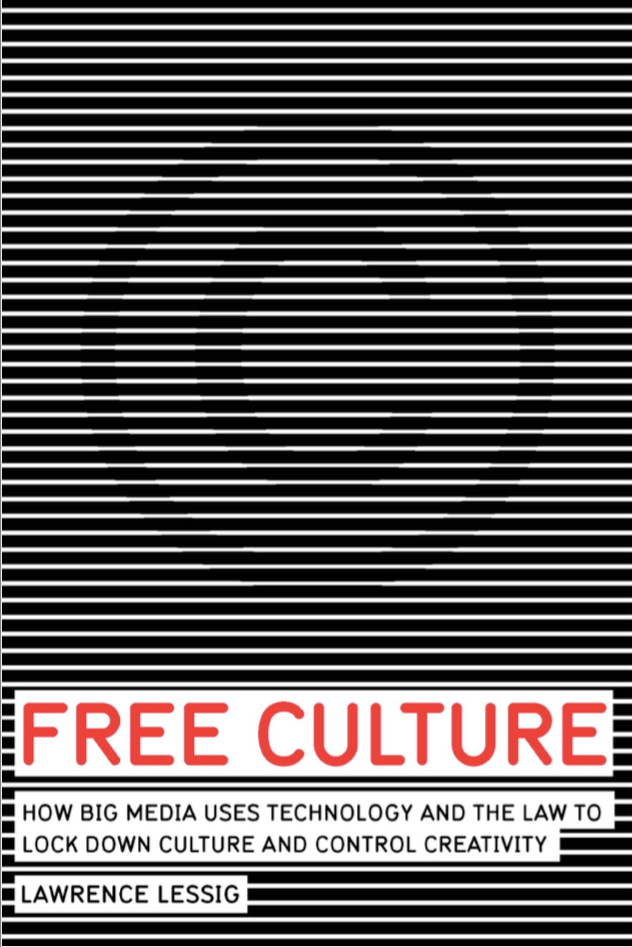
Messages Image(2315511253)

Lawrence Lessig, Free Culture: The Nature and Future of Creativity (available in PDF)

9780226032283

Patricia Aufderheide and Peter Jaszi, Reclaiming Fair Use: How to Put Balance Back in Copyright (available through your library or ILL)

remix_cover_small

Lawrence Lessig, Remix: Making Art and Commerce Thrive in the Hybrid Economy (available in PDF)

For Educators, Classroom Professionals, and Instructional Designers

33130_Hobbs_Copyright_72ppiRGB_150pixw

Renee Hobbs, Copyright Clarity: How Fair Use Supports Digital Learning (available through your library or ILL)

For Universities, Libraries, Archives, and Museums

Hirtle-Copyright_final_RGB_lowres-cover1.pdf

Hirtle, Peter B.; Hudson, Emily; Kenyon, Andrew T., Copyright and Cultural Institutions: Guidelines for Digitization for U.S. Libraries, Archives, and Museums  Book  [PDF]   (1.749Mb))

3rdCrews_200x300

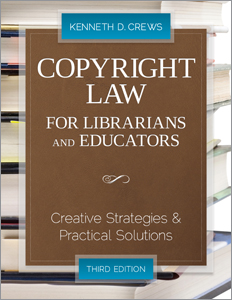
Kenneth Crews, Copyright Law for Librarians and Educators: Creative Strategies and Practical Solutions (available through your library or ILL)

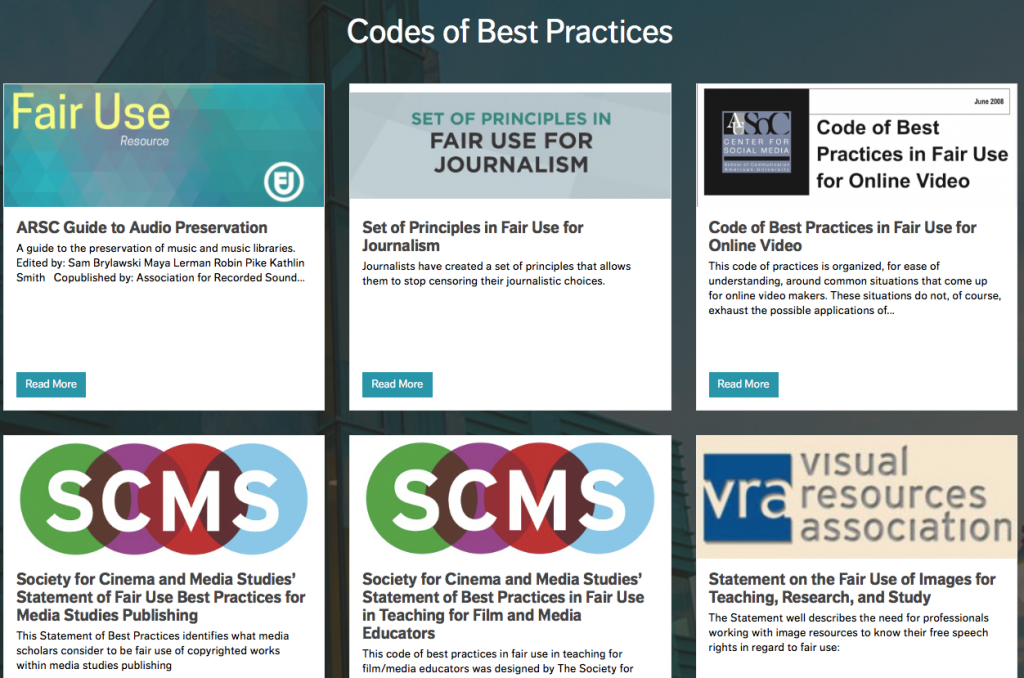
Fair Use Best Practices Guides

These best practices guides are use-specific. Visit them to see if there’s one that most closely matches your use scenario.

Find all of them here.

Filed Under: Fair Use Tagged With: Fair Use Week 2017

Fair Use Myths & Facts #WeAreFairUse

February 20, 2017 by Brandy Karl

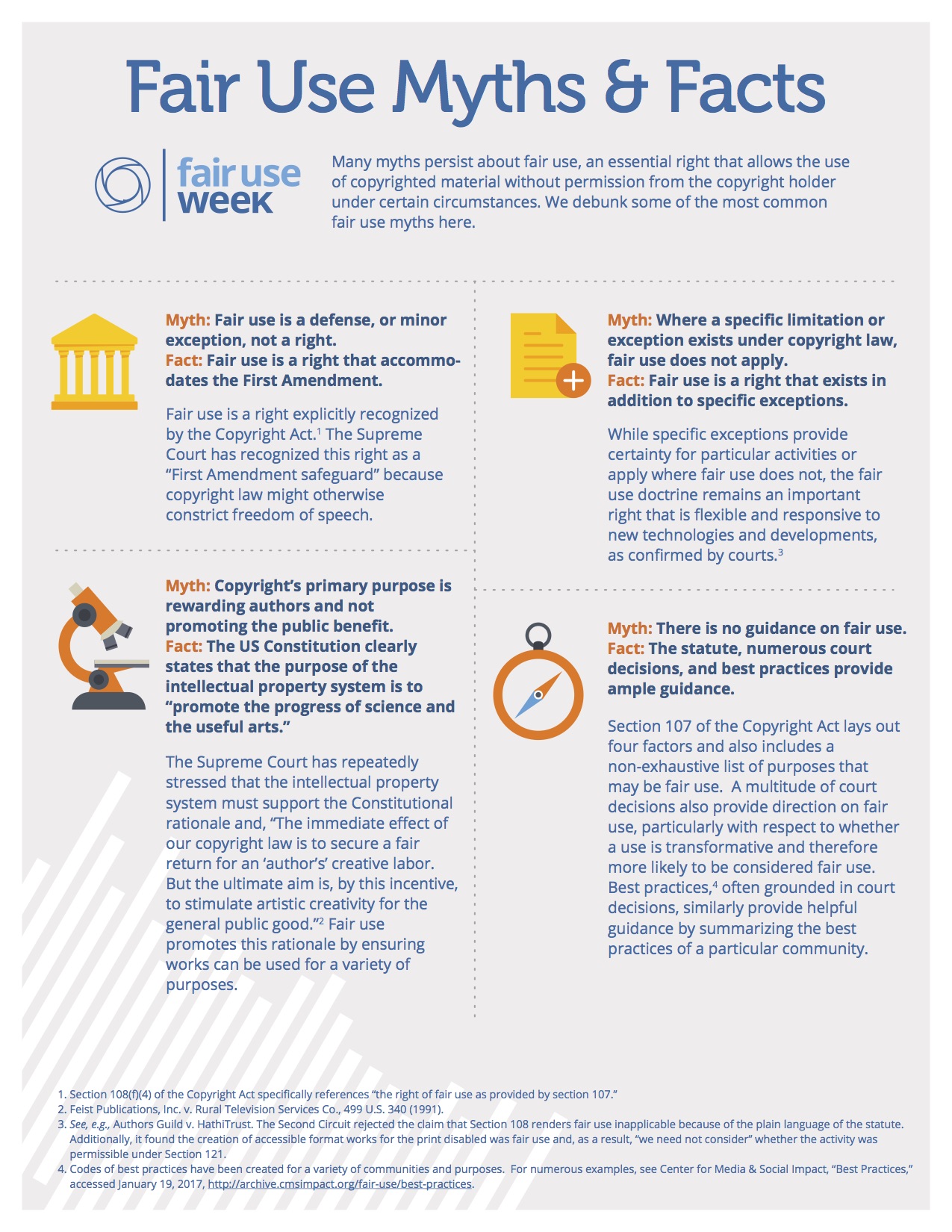
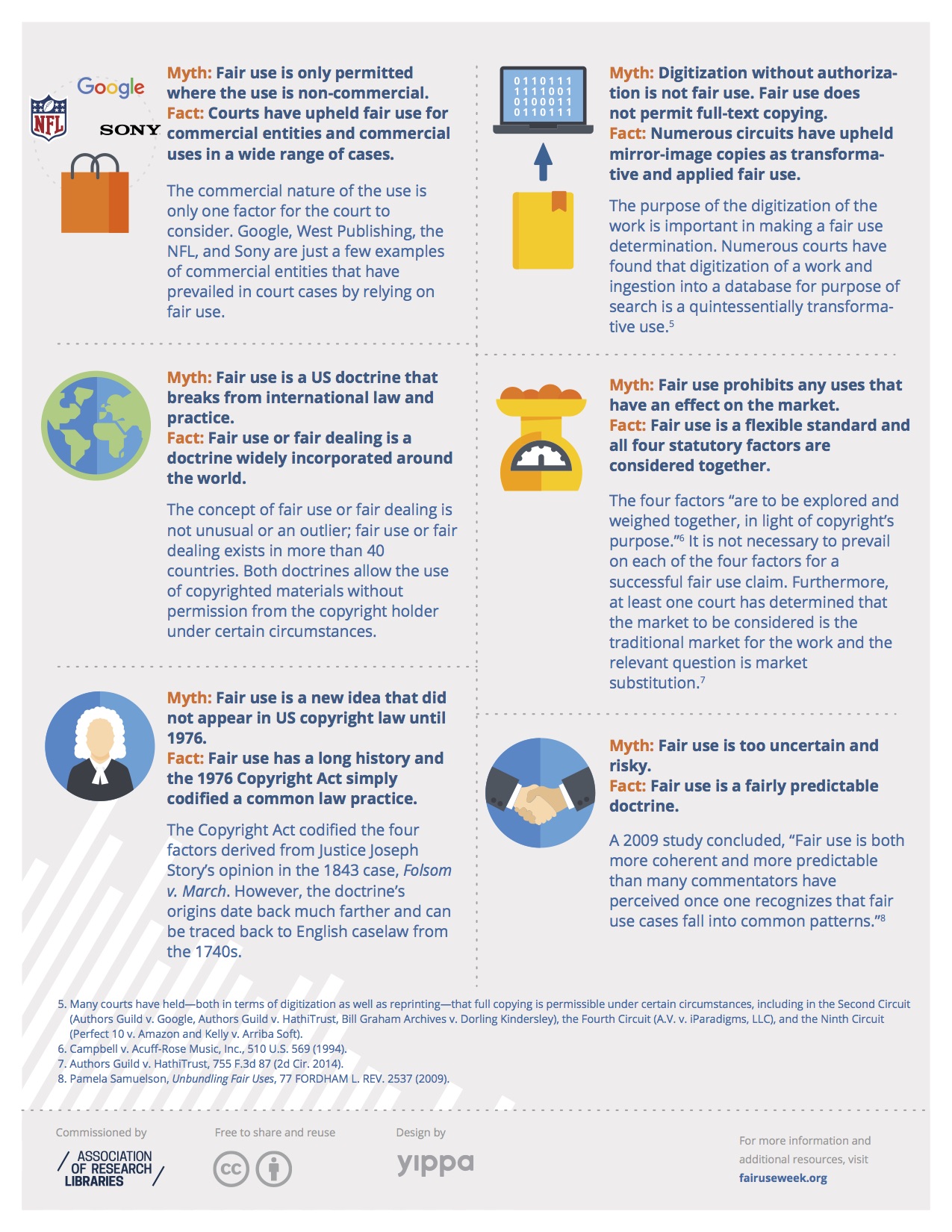
A great look at how fair use enables your every day college lifestyle! From the Association of Research Libraries (CC BY), check out this infographic.

What Fair Use Myths will you find out aren’t true?

Many myths persist about fair use, an essential right that allows the use of copyrighted material without permission from the copyright holder under certain circumstances. We debunk some of the most common fair use myths here.

Read more about Fair Use Week 2017 at PSU here.

  • Fact: Fair use is a right that accommodates the First Amendment.
  • Fact: The US Constitution clearly states that the purpose of the intellectual property system is to “promote the progress of science and the useful arts.”
  • Fact: Fair use is a right that exists in addition to specific exceptions.
  • Fact: The statute, numerous court decisions, and best practices provide ample guidance.
  • Fact: Courts have upheld fair use for commercial entities and commercial uses in a wide range of cases.
  • Fact: Numerous circuits have upheld mirror-image copies as transforma- tive and applied fair use.
  • Fact: Fair use or fair dealing is a doctrine widely incorporated around the world.
  • Fact: Fair use is a exible standard and all four statutory factors are considered together.
  • Fact: Fair use has a long history and the 1976 Copyright Act simply codi ed a common law practice.
  • Fact: Fair use is a fairly predictable doctrine.

Filed Under: Fair Use Tagged With: Fair Use Week 2017, Infographic

  • 1
  • 2
  • Next Page »

Schedule an Appointment

Submit a Request

Submit copyright and scholarly communications questions and requests for consultations & trainings using the Request Form

DISCLAIMER

The information on this site and from the Office of Scholarly Communications and Copyright at PSU Libraries is not legal advice and is provided for informational purposes only. The Office of Scholarly Communications & Copyright is not counsel to any members of the PSU community.

License

© 2022 The Pennsylvania State University. All rights reserved. Except where otherwise noted, this work is subject to a Creative Commons Attribution 4.0 license. Details and exceptions.

 Visit the Pennsylvania State University Home Page
Copyright 2026 © The Pennsylvania State University Privacy Non-Discrimination Equal Opportunity Accessibility Legal

Copyright © 2026 · Genesis for PSU on Genesis Framework · WordPress · Log in