
• Log In
 Visit the Pennsylvania State University Home Page

Copyright Information

For university teaching and research

  • Copyright
    • Fair Use
    • Creative Commons Licenses
    • Permission and Licenses
    • Public Domain
    • TEACH Act
    • Copyright for Theses and Dissertations
    • External Resources
  • Open Access
  • Workshops
    • Intro Series
  • Contact
  • Appointments
  • Blog
  • Faculty & Staff
  • Students
  • Fair Use
  • PSU Policy
    • Other Places for Help
  • FAQ

Summer 2024 Workshops

May 20, 2024 by Ana Enriquez

We are happy to announce summer workshops from the Office of Scholarly Communications and Copyright. All of these workshops will take place on Zoom. These workshops are open to the Penn State University community and the public. SARI credit is available for several of these workshops. Please register in advance using the links below.

For more information about our workshop program, please visit our Workshops page. With questions, please contact us at copyright@psu.edu.

Penn State encourages qualified persons with disabilities to participate in its programs and activities. If you anticipate needing any type of accommodation or have questions about the physical access provided, please contact us at copyright@psu.edu in advance of your participation or visit.

Copyright in One Hour, June 4, 10-11 a.m., Zoom

Please register on Zoom.
This workshop provides a brief introduction to U.S. copyright law, focusing on its impact on university research and teaching. You will learn what copyright covers and how copyrighted works enter the public domain. You’ll also learn about fair use and other rights that copyright gives to people using copyrighted material. This workshop will also serve as an introduction to the Summer 2024 workshop series from the University Libraries’ Office of Scholarly Communications and Copyright. Ana Enriquez will teach this workshop. Participants will earn SARI credit.

Using the Researcher Metadata Database, June 6, 10-11 a.m., Zoom

Please register on Zoom.
In this training, you will learn how to use the Researcher Metadata Database to share your scholarly articles with the public under Penn State’s open access policy. You will also learn other options for following up with open access policy reminder emails, including uploading files in Activity Insight, providing links to open copies of your articles, or getting waivers of the policy. Ana Enriquez will teach this training.

Sharing Research Software with Open Source Licenses, June 6, 4-5 p.m., Zoom

Please register on Zoom.
Open source software development is increasingly common in many areas of academic work, however researchers who write software must balance a host of disciplinary and institutional expectations to share their code. This workshop provides an introduction to open source software licensing with particular focus on the needs of Penn State researchers. Topics include: the importance of software licenses, common open source licenses used in scientific software projects, and recommendations for navigating relevant university and funder policies. Ana Enriquez will teach this workshop. Participants will earn SARI credit.

Plagiarism and Attribution, June 18, 10-11 a.m., Zoom

Please register on Zoom.
This workshop will provide an introduction to plagiarism and attribution, including an overview of university policies related to these topics. You will learn how plagiarism differs from copyright infringement and when attribution is relevant to copyright law. You will also learn about text recycling (sometimes called “self-plagiarism”) and about plagiarism and attribution as they relate to the use of generative AI tools such as ChatGPT. Ana Enriquez will teach this workshop. Participants will earn SARI credit.

Copyright and Generative AI, June 18, 4-5 p.m., Zoom

Please register on Zoom.
This workshop will provide an introduction to copyright issues related to generative AI tools such as ChatGPT, Copilot, and Stable Diffusion. The law in this area is in flux, so we’ll study recent developments as well as relevant precedent on three questions. Are works created with generative AI tools copyrightable? Is it fair use to train a large language model on in-copyright material? And finally, is it fair use to use a generative AI tool to create a new work that is “substantially similar” to an in-copyright work? Ana Enriquez will teach this workshop. Participants will earn SARI credit.

Copyright in Three Hours, June 20, 1-4 p.m., Zoom

Please register on Zoom.

This workshop provides a detailed introduction to U.S. copyright law. Through a combination of prerecorded videos, small group discussion, full group discussion, and short breaks, you will learn to apply copyright law to scenarios like those that come up at Penn State, including research- and course-related uses. This workshop will go into additional detail on the topics covered in the Copyright in One Hour workshop (copyrightability, the public domain, and fair use). It will also cover additional topics, including how courts determine whether one work counts as a copy of an earlier work, who counts as the author of a copyrighted work (including jointly authored works and works made for hire), and how copyrights are licensed or transferred. This workshop is recommended for participants who want to bring together previous copyright training into a holistic understanding of U.S. copyright law. Ana Enriquez will teach this workshop.

Using Creative Commons Licensed Material, June 25, 2-3 p.m., Zoom

Please register on Zoom.
Don’t understand the difference between Creative Commons ShareAlike and NoDerivatives licenses? Aren’t sure where to find great Creative Commons licensed content? Do you want to license your content with a Creative Commons license but don’t know which one to use? Are you curious about Creative Commons licenses? Join Danielle Steinhart, Copyright Specialist, for a workshop on these and other questions. This is an interactive workshop. After an overview from Danielle, workshop participants will work in small groups to address hypothetical Creative Commons questions and then debrief their responses as a full group. Participants will earn SARI credit.

Copyright and Accessibility, June 27, 2-3 p.m., Zoom

Please register on Zoom.
Are you curious about how copyright law interacts with making copyrighted works accessible to people with disabilities? Not sure if you can remediate a pdf for readability or add captions to a video? This workshop is for you. Join Danielle Steinhart, Copyright Specialist, for a workshop on these and other questions. This is an interactive workshop. After an overview from Danielle, workshop participants will work in small groups to address hypothetical copyright questions and then debrief their responses as a full group..
Filed Under: Copyright Law, PSU Copyright News, Scholarly Communications

Penn State Celebrates Fair Use Week 2017 #WeAreFairUse

February 20, 2017 by Brandy Karl

Messages Image(600065454)

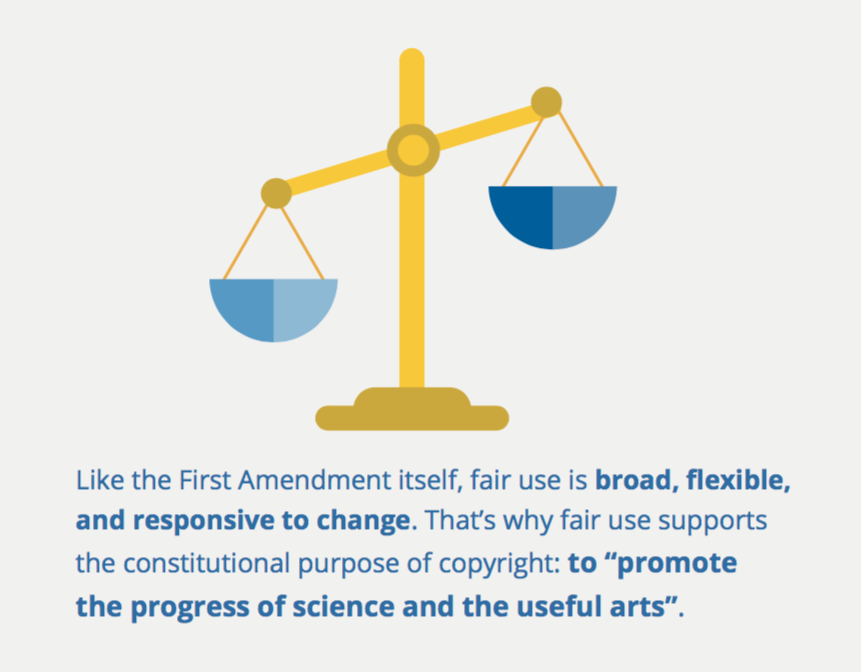
Fair Use Fundamentals infographic, from Fair Use Week (CC BY)

February 20-24, 2017 marks Fair Use Week, a celebration of users’ rights in copyright law. This year we are celebrating with the release of the first iteration of the Fair Use Suite, a set of resources designed for PSU faculty, staff, and students, including a downloadable fair use checklist, a fair use reminder card, and more to come throughout the year.

What Is Fair Use?

Fair Use is an integral part of copyright law – it’s the legal doctrine that allows users and creators to build upon and incorporate the past without permission of copyright owners. It allows us to reuse, remix, archive, parody, criticize, and comment on previous works. It also allows technological uses like indexing copyrighted works so users may search for them, time-shifting tv shows to watch later, and creating accessible copies of copyrighted works for the disabled. Fair Use supports the constitutional mandate that copyright serves to promote the progress of science and the useful arts. (In 18th century speak, that’s learning and science, in that order!)

How Do I Know Something Is a Fair Use?

While many factors are considered, there is a 4 factor test codified in 17 USC § 107 is always used (brief explanations in bold)

  1. the purpose and character of the use, including whether such use is of a commercial nature or is for nonprofit educational purposes; is it transformative?
  2. the nature of the copyrighted work; is it factual? creative? 
  3. the amount and substantiality of the portion used in relation to the copyrighted work as a whole; have you used more than necessary? and
  4. the effect of the use upon the potential market for or value of the copyrighted work. does your use impinge on the market for the work?

Using the four factors isn’t black and white – they are taken all together, and must be evaluated for every copyrighted work used – it’s a case by case analysis.

#WeAreFairUse 2017

Penn State University and the Penn State Libraries embrace the usefulness of fair use and its necessity in fulfilling our mission of teaching, research, and service and to inspire intellectual discovery and learning through robust information resources and academic collaborations in teaching and research that connect the Penn State community and citizens of Pennsylvania to the world of knowledge and new ideas.

This week, take a moment to learn more about Fair Use.

Fair Use Week Events and Posts

What can you do to celebrate Fair Use Week?

  • Confused about Fair Use? See the infographic that destroys Fair Use Myths & Facts!
  • Get the Fair Use Suite (coming later this week!)
  • Check out the National Fair Use Week site for a complete listing of webinars and blog posts to learn more about fair use.
  • Schedule a consultation with the copyright officer for answers and information about your copyright conundrums. Just email copyright@psu.edu!
  • Follow the #FairUseWeek2017 hashtag on Twitter
  • Learn about how the Libraries remake the meaning of archival items through curation. (2015)
  • See how fair use applies to the day-to-day life of a college student.
  • Check out this collection of mashup shirts – do you think they’re fair use?

Filed Under: Fair Use, PSU Copyright News Tagged With: Fair Use Week 2017

Maximizing Your Libraries’ Resources: Copyright, Publishing, and Research Reputation Workshop {Postponed}

February 5, 2016 by Brandy Karl

This event was postponed due to weather.

February 16, 2016, at 5:30 p.m.
112 Kern Graduate Building

Register now (registration closes on Feb. 15, 2016) or
watch the livestream on Feb. 16, 2016

The University Libraries is pleased to invite all graduate students to Maximizing Your Libraries’ Resources: Copyright, Publishing, and Research Reputation. This 60-minute professional development workshop on Feb. 16, 2016, at 5:30 p.m. in 112 Kern Graduate Building will be livestreamed and recorded.

Maximizing Your Libraries’ Resources: Copyright, Publishing, and Research Reputation will offer information, resources, and insights essential to the sophisticated researcher. Topics will include:

  • Copyright and the use and creation of content;
  • Infringement;
  • Plagiarism;
  • Publishing and making your work openly accessible;
  • Penn State’s ScholarSphere;
  • Managing your online scholarly/professional presence;
  • Privacy concerns; and
  • The Open Research and Contributor ID (ORCID).

The University Libraries will also be asking for your input about what additional services they could offer to help enhance your graduate experience. Please bring your thoughts and suggestions.

Do not miss this session! Your attendance will help increase your researcher savviness…guaranteed!

Filed Under: PSU Copyright News

Schedule an Appointment

Submit a Request

Submit copyright and scholarly communications questions and requests for consultations & trainings using the Request Form

DISCLAIMER

The information on this site and from the Office of Scholarly Communications and Copyright at PSU Libraries is not legal advice and is provided for informational purposes only. The Office of Scholarly Communications & Copyright is not counsel to any members of the PSU community.

License

© 2022 The Pennsylvania State University. All rights reserved. Except where otherwise noted, this work is subject to a Creative Commons Attribution 4.0 license. Details and exceptions.

 Visit the Pennsylvania State University Home Page
Copyright 2026 © The Pennsylvania State University Privacy Non-Discrimination Equal Opportunity Accessibility Legal

Copyright © 2026 · Genesis for PSU on Genesis Framework · WordPress · Log in